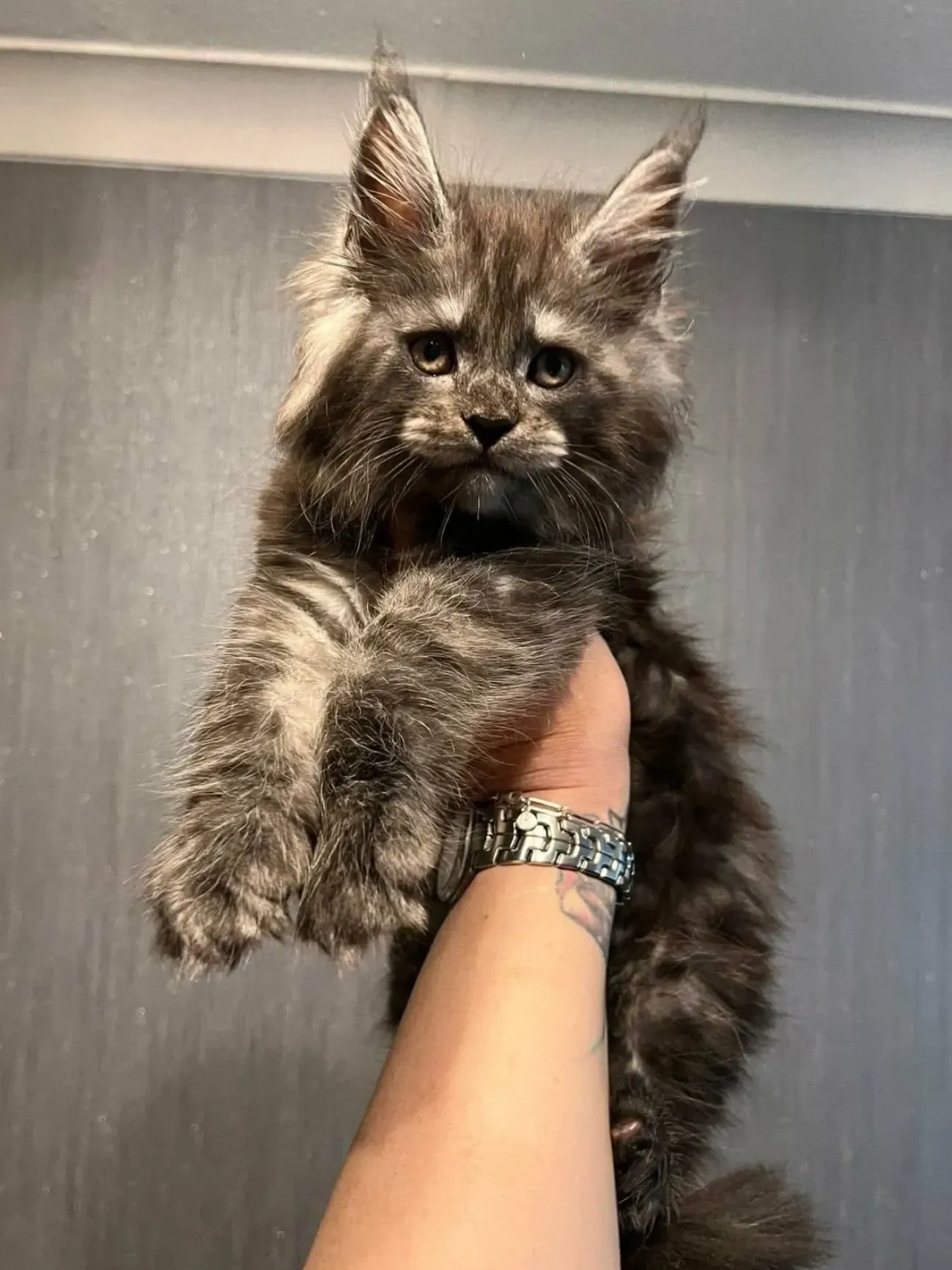
Importing any pedigree cat into Singapore follows the same regulatory spine: microchip, rabies vaccination, serology, the waiting periods, the import licence and the arrival inspection. The Maine Coon is no exception. But the breed introduces a few practical differences that are worth understanding before you commit to a timeline or a budget, and most of them come down to one fact: this is a large animal.
We run a Maine Coon cattery, so the points below are not theoretical. They are the things we plan around every time a cat travels.
Why size is the first thing to plan around
Maine Coons are one of the largest domestic cat breeds. They are long-bodied, heavy, and slow to mature — many keep filling out until around three to four years of age. A cat that looks fully grown at twelve months may still gain length and weight well beyond that point.
This matters because the crate is not a fixed cost. Under the IATA Live Animals Regulations, the travel crate must allow the cat to stand fully upright, turn around, and lie down in a natural position. For an average cat, that is a routine medium crate. For a Maine Coon, it often means stepping up a crate class — sometimes more than one.
The crate is sized to the cat, not to the species. With a Maine Coon, you size it to an unusually long, tall animal, and that single decision flows through to the cargo cost.
A larger crate occupies more volume in the aircraft hold, and air cargo for live animals is typically priced on the larger of actual or volumetric weight. So the crate that keeps the cat comfortable and compliant is also the crate that pushes the shipment into a higher cargo band. This is normal for the breed and worth budgeting for from the start rather than discovering late.
There is a second-order effect worth naming. Because Maine Coons mature slowly, the cat you crate-train at one age may genuinely be larger by the time it travels. If a move is planned a long way out, it is safer to size the crate against the cat the animal will be on flight day rather than the cat it is today. A crate that is comfortable now but tight in six months is not a saving — it is a compliance problem waiting to surface at booking or inspection. Sizing generously, within the IATA standard, is the conservative call for this breed.
Crate class and what it implies
The table below shows how crate sizing maps to the cost components you will see on a Europe-to-Singapore move. Exact figures depend on the individual cat, the airline and the season, but the ranges are representative.
| Crate weight class | Typical cat profile | Crate cost (S$) | Cargo band implication |
|---|---|---|---|
| Smaller class | Average adult cat | 180–280 | Lower end of cargo range |
| Larger class | Adult Maine Coon, fully grown | 320–450 | Upper end of cargo range |
| Air cargo (Europe → SIN) | Varies by crate volume/weight | — | 2,200–3,800 |
The practical reading: a Maine Coon will usually sit at the upper end of both the crate cost and the cargo range. If you are comparing a budget you saw for a smaller breed against a Maine Coon move, expect the Maine Coon figure to be higher for the same route, and the difference is driven almost entirely by physical size.
One area where the breed is an advantage
It is worth saying clearly, because it is often assumed otherwise: the Maine Coon is not a brachycephalic breed. It does not have the shortened, snub-nosed skull of breeds like the Persian or Exotic Shorthair.
That is a genuine welfare and logistics advantage. Brachycephalic cats can struggle with airflow and temperature regulation under the stress of travel, and a number of airlines place restrictions — or outright embargoes — on flat-faced breeds in the hold for exactly that reason. The Maine Coon's normal muzzle and open airway mean it does not fall under those breathing-related flight restrictions.
So while the breed costs more to fly because of its size, it does not carry the booking difficulties and breed-specific refusals that a snub-nosed cat can. In planning terms, that removes a layer of uncertainty. When we look at routings for a Maine Coon, the decision is about volume, temperature and layover length — not about whether a carrier will accept the breed at all. That makes the planning more predictable than it is for many other pedigree cats, even if the headline cargo figure is higher.
The regulatory pathway from Europe
Most Maine Coons imported into Singapore come from European source countries, and most of those countries sit in Schedule II of Singapore's import framework — the controlled-risk category. The Schedule II sequence is strict on order, and the order is where people most often slip.
The steps must happen in this sequence:
- Microchip first. An ISO-standard microchip must be implanted before the rabies vaccination. If the chip is read after the vaccine, the vaccination record may not be accepted as linked to the animal.
- Rabies vaccination, recorded against that microchip.
- Wait at least 28 days after vaccination before the next step.
- Rabies serology (RNATT) — a blood titre test showing a result of at least 0.5 IU/ml.
- A 90-day wait measured from the date the satisfactory blood sample was taken, before the cat may be exported.
Because of the 28-day wait, the 90-day serology wait, and the lead times for booking and paperwork on top, a realistic end-to-end timeline from a Schedule II country is around six to seven months. That is not a figure to compress. The 90-day clock in particular cannot be shortened, and the sequence cannot be reordered.
Indicative timeline
| Stage | Approximate timing |
|---|---|
| Microchip implanted | Day 0 (before vaccination) |
| Rabies vaccination | Day 0–7 |
| Wait after vaccination | Minimum 28 days |
| RNATT serology blood draw | After the 28-day wait |
| Export wait period | 90 days from a satisfactory blood draw |
| Licensing, booking, export prep | Overlapping the above |
| Earliest realistic travel | ~6–7 months from start |
The reason we lay the timeline out this way is that the waiting periods overlap with administrative work but cannot be skipped. The serology must succeed on the first attempt to keep to schedule; if a titre comes back below 0.5 IU/ml, the cat needs revaccination and the clock effectively restarts, which can add months. Working back from a desired arrival date is the only sensible way to plan.
Costs at the Singapore end
Two cost items sit on the Singapore side of the move and are easy to overlook when you are focused on the cargo quote.
First, import GST. Singapore charges 9% GST on the declared import value of the cat. For a pedigree Maine Coon, the declared value is not trivial, so the GST line is a real number rather than a rounding error. It is worth establishing the declared value early so the figure does not surprise you at clearance.
Second, the AVS import licence. Every cat entering Singapore requires an import licence from the Animal and Veterinary Service, and the licence is tied to the import window and the arrival inspection at the Changi Animal and Plant Quarantine (CAPQ) facility. The licence is not a formality you arrange after the cat has flown — it is part of the front-end planning, and it has to align with the export timeline coming out of Europe. For a Maine Coon, none of this differs from any other cat. It is simply part of the same paperwork chain that has to be sequenced correctly alongside the serology and the booking.
A rule change you need to know about
There is a regulatory change that affects how clearance works at the border. From 1 April 2026, owners can no longer clear their own pets at CAPQ themselves. The arrival clearance must be handled by an AVS-recognised pet agent.
This is a meaningful shift. Previously a hands-on owner could, in principle, manage the arrival step directly. After that date the recognised-agent route is the path for clearing the animal at quarantine.
A note on our own status, because we want to be precise about it. MAINECOON CATTERY SG is an AVS-licensed pet shop (licence AS24E00026), and we operate a working Maine Coon cattery, so the breed-specific side of this is first-hand for us. Our AVS pet-agent recognition is currently an application in progress. We are not yet a recognised pet agent, and we will not describe ourselves as one until that recognition is granted. We mention this so you can plan with accurate information about who can do what at the CAPQ clearance step.
Welfare planning for a large cat
The welfare considerations that apply to any cat in cargo apply more sharply to a large one, simply because there is more animal, more crate, and more sensitivity to heat and confinement.
A few things matter in particular:
- Crate acclimatisation well ahead of travel. A Maine Coon should be familiar and relaxed with its crate long before flight day. With a larger crate that takes more lead time, not less — the cat needs to associate the bigger space with calm rather than novelty. Rushing this is the most common avoidable welfare error.
- Climate control along the route. Large, heavily coated cats are more vulnerable to heat. Routing, hold conditions and ground handling temperatures all matter, and the booking should be chosen with that in mind.
- Hydration. Long transits make water access important. Crates are fitted appropriately so the cat can drink during the journey.
- Minimal layovers. Every additional stop adds handling, temperature variation and stress. A routing with fewer and shorter layovers is materially kinder to a large cat, and is generally worth paying for.
These are not optional extras for the breed. The combination of size, coat and a long-haul flight is exactly the situation where careful routing and proper acclimatisation make the difference between a settled arrival and a distressed one.
Bringing it together
The Maine Coon is, in import terms, a study in trade-offs. The size that defines the breed raises the crate class and the cargo cost, and demands more deliberate welfare planning. At the same time, the breed's normal muzzle keeps it clear of the flight restrictions that complicate brachycephalic cats, which removes a real source of booking risk.
Everything else — the Schedule II sequence from Europe, the roughly six-to-seven-month timeline, the 9% GST, the AVS import licence, and the recognised-agent requirement from 1 April 2026 — applies as it does to any pedigree cat. The breed-specific work is mostly about size and welfare, and that is the part we know intimately.
If you want to see the kind of cats this guide is written around, our sister site is the Gentle Giants Maine Coon cattery. For the regulatory and logistics side of moving a cat to Singapore, you can read more about our relocation services.
When you are ready to map out a timeline for a specific cat and route, reach out through the contact page and we will talk it through.
Thinking about your own import?
We can carry the whole chain.
From a one-off planning call to a fully managed move, see how our packages work — or just tell us where your pet is.